)

Chapter 1
I walked down a street. There is a deep hole in the sidewalk. I fall in. I am lost…I am helpless. It isn’t my fault. It takes forever to find a way out.
Chapter 2
I walked down the same street. There is a deep hole in the sidewalk. I pretended I don’t see it. I fall in again. I can’t believe I am in this same place. But, it isn’t my fault. It still takes a long time to get out.
Chapter 3
I walk down the same street. There is a deep hole in the sidewalk. I see it is there. I still fall in…it’s a habit…but, my eyes are open I know where I am. It is my fault. I get out immediately.
Chapter 4
I walk down the same street. There is a deep hole in the sidewalk. I walk around it.
Chapter 5
I walk down another street.
Why We Keep Returning to the Same Patterns
Portia Nelson’s Autobiography in Five Short Chapters is often used in therapeutic settings because it captures something deeply human: change rarely happens all at once. We may repeat a painful pattern, recognize it only after the fact, notice it as it happens, choose differently, and eventually build a life in which the old route no longer defines us.
The progression is not a story of weakness becoming strength so much as of unconscious repetition becoming conscious choice. Stephen Covey’s three circles help explain this journey: what is beyond our control, what we can influence, and what is within our control.
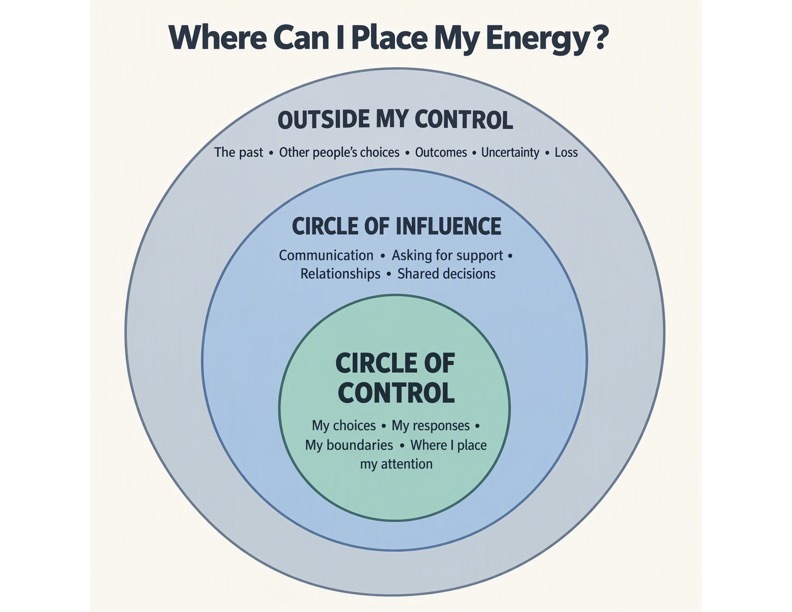
Chapter One: Powerlessness in the Circle of Concern
In the first chapter, the person encounters the obstacle unexpectedly and experiences confusion, helplessness, and a slow recovery.
Psychologically, this resembles living almost entirely within the Circle of Concern. The problem feels like something that simply happens to us, while our options remain hard to see.
This can occur in response to trauma, entrenched relationship dynamics, anxiety, depression, or coping habits learned long ago.
When the nervous system is overwhelmed, access to reflection and choice may narrow; what appears from the outside to be passivity may actually be survival.
The therapeutic task here is not to demand accountability before safety exists. It is to reduce shame, name what happened, and help the person recognize even a small point of control: asking for help, pausing, noticing a feeling, or choosing what to do next.
Agency often begins as a very small opening.
Chapter Two: Recognition Without Readiness
In the second chapter, the pattern repeats, and a faint sense of familiarity emerges, yet responsibility still feels external. This is the uncomfortable space between awareness and readiness.
A person may recognize that certain conversations become destructive, that overcaring breeds resentment, that overwork leads to collapse, or that avoidance intensifies anxiety, yet still feel unable to interrupt the sequence.
The Circle of Influence is beginning to appear, but it has not yet become a reliable place to stand.
It is tempting to label this stage as denial. A more useful therapeutic question is: “What makes the familiar pattern feel safer than the unknown alternative?”
Ambivalence may be protecting attachment, identity, predictability, or emotional survival. Change becomes more likely when curiosity replaces accusation and when the person identifies a response they can influence without claiming control over the whole situation.
Chapter Three: Awareness Inside the Pattern
By the third chapter, the person recognizes the obstacle and understands the role of habit, yet still repeats the behaviour.
This is a major shift. Awareness has moved from hindsight into the present moment.
In Covey’s terms, attention is moving inward—from what happened to what can be done now.
The person cannot erase the obstacle or the history that made the route familiar, but can control the speed and direction of recovery.
This stage also requires a clear distinction between taking ownership and assigning blame, because blame often causes shame, which can lead to getting stuck.
Responsibility says, “I (or they) have a role in what happens next.” Blame and shame say, “There is something wrong with me (or them), and I (or they) will never change.”
The first expands the Circle of Control; the second often collapses it through shame.
Progress may look like noticing a trigger sooner, recovering more quickly, apologizing, using a coping skill, or leaving an unsafe interaction. Falling back into an old pattern does not erase growth when the way out is becoming clearer.
Chapter Four: Choosing a Different Response
In the fourth chapter, awareness becomes prevention. The obstacle remains, but the person responds differently. This is the Circle of Control in practice: not controlling the street, the obstacle, the past, or other people, but choosing a boundary, a pause, a coping strategy, or a new behaviour.
Repetition has provided enough learning for a different response to become available.
Clinical change often looks this ordinary. A person notices activation and takes a breath before replying. They decline a request that would cause resentment. They call a supportive friend instead of isolating. They prepare for a predictable trigger.
Choosing effective responses doesn't make obstacles disappear; it prevents an unwanted outcome and fosters transformation. Each repeated choice strengthens self-trust and may gradually expand a person’s understanding of the Circle of Influence.
When Help Becomes an Unspoken Contract
Consider someone who repeatedly asks for help with a difficult situation. We listen, offer practical support, adjust our schedules, share our resources, and help them access public resources.
They accept help, and we assume they will now make the changes we believe are necessary. When they return to the same pattern, we may feel disappointed, frustrated, or resentful: “After everything I did, why haven’t you changed?!”
Resentment can signal that our gift carried an unspoken contract: “I will help you, and in return you will change in the way and on the timeline I expect.”
This is natural. After all, society expects reciprocal behaviour.
At the same time, we can ease our tension by remembering that we can control only how we communicate, the support we offer, and the limits we set. But not the other person's readiness or desire to change.
We can continue to care deeply, set boundaries, and decide what we are willing to offer without sacrificing our well-being. We can stop trying to change another person, acknowledge the hope underlying our expectations, and allow the other person to experience the natural consequences of their choices.
Chapter Five: Redesigning the Route
In the fifth chapter, the person no longer organizes life around avoiding the same obstacle.
Yet choosing a new route is not always immediately feasible. When discussing our agency, we must remember that we cannot ignore the context in which we live. Financial realities, caregiving duties, discrimination, illness, and safety concerns can limit our choices.
Sometimes the best action we can take is to seek support, make a gradual plan, protect our energy, or stop treating an uncontrollable condition as a personal failure.
Healing Is a Practice of Returning to Choice
Nelson’s five chapters offer a compassionate map of change: first, we feel trapped; then we recognize repetition; then we become aware of it; then we respond differently; and eventually we create a new path.
Well-being doesn't mean everything will always be tidy and easy. Under stress, we may move back and forth between chapters. The objective is to know how we want to show up for ourselves and for others. This means staying self-aware, knowing when to seek support, and being willing to own our choices and learn from their consequences, whether or not the outcome is what we wanted.
A useful reflection is to ask: What is out of my control? What might I be able to influence? What is one thing I can control today? The final question should be small enough to answer honestly. We may not control the obstacle's presence, but with compassion, practice, and support, we can strengthen our capacity to notice where we are and to choose the next steps that sustain our well-being.
)
Isabel Bleim
Contact Me